Oil Prices and the Renewables Debate
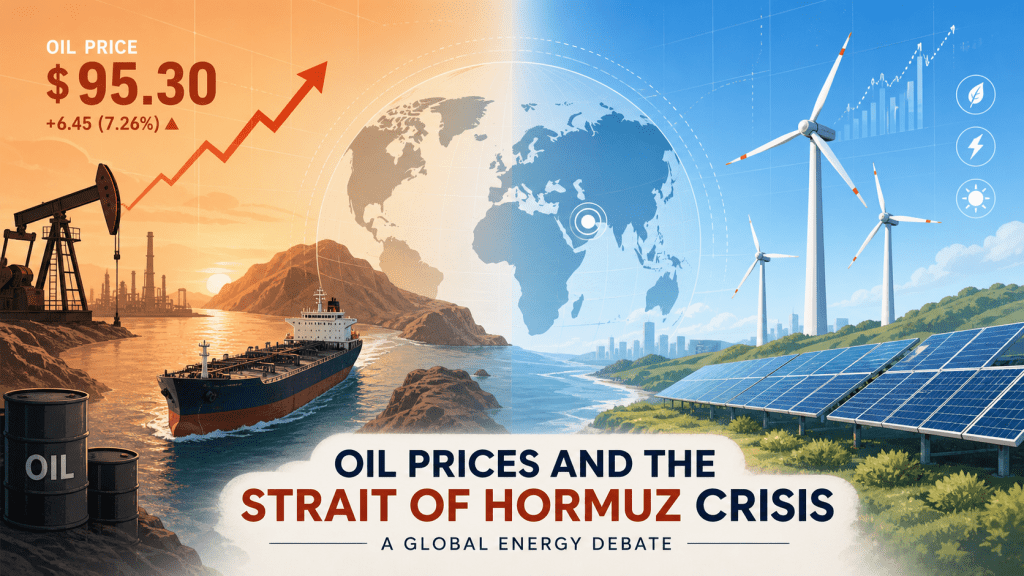
The Strait of Hormuz is a narrow waterway that carries around one-fifth of the world’s oil and gas supplies. Recent conflict in the region caused serious disruption to global oil markets, and Brent crude prices rose sharply, highlighting how quickly global energy markets can react to geopolitical tensions. This price shock has renewed a global debate about whether countries should speed up their shift to renewable energy or continue relying on fossil fuels.
Supporters of renewable energy argue that oil often passes through politically unstable regions, so prices can rise suddenly whenever tension increases. Renewable energy sources such as solar and wind do not depend on shipping routes or foreign suppliers, making them far less vulnerable to geopolitical shocks. In addition, the cost of renewable technology has fallen sharply over the past decade, and in many countries new solar and wind projects are now cheaper than fossil fuel alternatives.
Other experts, however, believe fossil fuels remain essential, at least for now. Solar and wind power depend on weather conditions, and many countries still lack enough storage technology to guarantee a constant electricity supply. Oil and gas continue to power global transport and heavy industry, sectors that cannot switch to renewable energy overnight, and critics warn that moving away from fossil fuels too quickly could cause energy shortages and higher prices.
Many analysts therefore argue that relying too heavily on a single energy source leaves economies vulnerable to shocks. As the Hormuz crisis has shown, diversifying energy supply is likely to become an increasingly important strategy in the years ahead.
Sentence Completion
Complete the sentences below. Choose NO MORE THAN TWO WORDS from the passage for each answer.
1. The Strait of Hormuz carries around one-fifth of the world’s oil and __________.
2. Brent crude prices rose __________ after the disruption.
3. Renewable energy does not depend on shipping routes or __________.
4. Many countries still lack enough __________ technology for renewable electricity.
5. Relying too heavily on a __________ energy source leaves economies vulnerable.
Multiple Choice
Choose the correct letter: A, B, C or D.
6. Why do supporters of renewables say fossil fuels are risky?
A. They are too expensive to produce
B. They depend on politically unstable regions
C. They cannot be transported by ship
D. They require constant government subsidies
7. What problem do critics identify with renewable energy?
A. It cannot be produced cheaply
B. It depends on weather conditions
C. It always increases energy bills.
D. It causes higher carbon emissions
8. What is the writer’s overall conclusion?
A. Fossil fuels should be replaced immediately
B. Renewables have already solved the energy crisis
C. Diversifying energy sources reduces economic risk
D. The Hormuz crisis has ended the debate permanently
Answer Key
1. gas supplies
2. sharply
3. foreign suppliers
4. storage
5. single
6. B
7. B
8. C

 English for Traveling